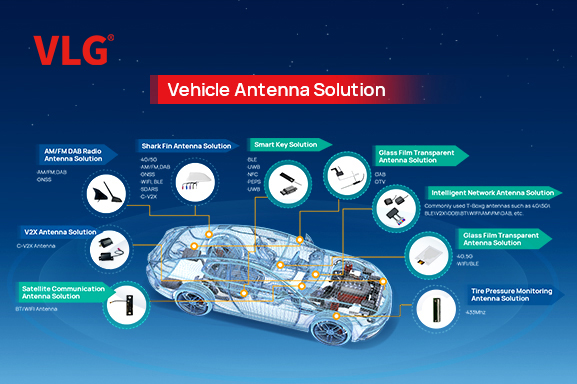
An automotive NFC antenna provides the close-range RF link used by a compatible vehicle digital key system. It can be integrated into a door handle, trim piece or another defined tap location. The antenna works with the NFC reader and credential system; successful integration requires both RF tuning and a usable physical interaction area.
Key specifications and selection criteria
| Item |
Details |
| Operating frequency |
13.56 MHz |
| Integration locations |
Door handle, trim or defined vehicle tap area |
| Electrical inputs |
Reader requirements, coil geometry and matching network |
| Mechanical inputs |
Space, nearby metal, covering material and mounting tolerances |
| Validation |
Representative credentials, orientations and assembled hardware |
Design the coil and reader together
NFC operation at 13.56 MHz relies on coupling between the reader antenna and the phone or credential. Select the coil geometry and matching network for the reader circuit. Check the installed resonance and reader requirements instead of applying a generic cellular-antenna specification.
Account for nearby metal and trim
Vehicle structures and coatings can affect the antenna. Include the final handle or trim materials, spacing and any required magnetic shielding in the evaluation. Test the intended tap position with representative devices and orientations.
Define the user interaction
A digital key needs a clear, repeatable tap area. Confirm the distance and alignment that the assembled system supports, including different phones or credentials. Mechanical tolerance and enclosure changes should be considered alongside the reader tuning.
Separate RF coupling from access security
The antenna supports communication. Authentication and access decisions belong to the reader, credential protocol and vehicle electronics. A short interaction range does not, by itself, establish resistance to every attack or compliance with a digital-key specification.
Prepare the OEM design inputs
Provide the reader chipset, coil-space constraints, housing materials, expected credential types and environmental requirements. VLG can evaluate a custom NFC antenna arrangement using these inputs. Validate the final assembly before setting a read-range or compatibility claim.
Frequently asked questions
Is an NFC antenna also a GPS antenna?
No. NFC and GNSS use different frequencies and functions. A digital-key antenna should not be described with GPS keywords unless a separate GNSS function exists.
Can the antenna work with any phone?
Compatibility depends on the credential and reader system as well as RF performance. Test the intended devices and configurations.
Explore related vehicle digital key antennas for your project.
Discuss your antenna project with VLG
Send VLG your required frequency bands, radio or receiver model, available installation space and cable requirements. Include the target application and order quantity so the team can review a suitable antenna configuration.
Request antenna specifications, samples or an OEM quotation.









 Home >
  +86 186 8871 1070


