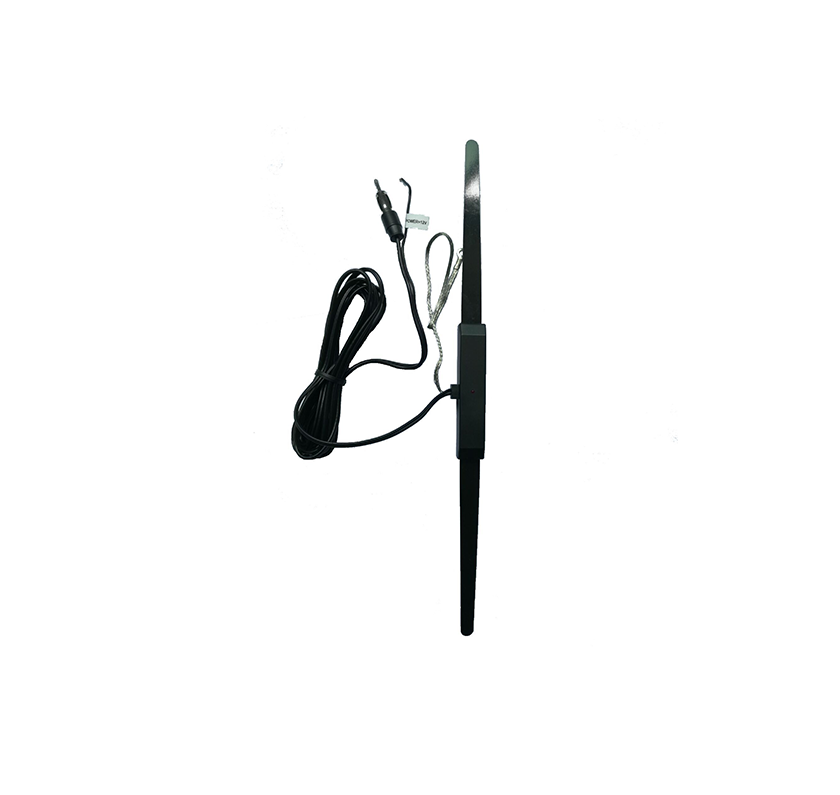
4G (LTE) and Wi-Fi antennas serve distinct purposes in wireless communication, shaped by their frequency bands, design requirements, and application scenarios. Here’s a detailed comparison:
1. Frequency Bands
4G Antennas:Operate in cellular bands, which vary by region:
Low-band: 600-900 MHz (e.g., LTE Band 5/8).
Mid-band: 1.8-2.1 GHz (e.g., LTE Band 3/7).
High-band: 2.3-2.6 GHz (e.g., LTE Band 40/41).
Example: A 4G antenna for North American LTE might cover 700 MHz (Band 12) and 1900 MHz (Band 2).
Wi-Fi Antennas:Focus on the ISM bands:
2.4 GHz (802.11b/g/n) and 5 GHz (802.11a/n/ac/ax).
6 GHz (802.11ax) for Wi-Fi 6E.
Example: A dual-band Wi-Fi antenna covers 2.4 GHz (2.400-2.4835 GHz) and 5 GHz (5.150-5.825 GHz).
2. Antenna Design
4G Antennas:
Often multi-band to support global roaming, using techniques like frequency stacking or switched filters.
MIMO antennas are common in smartphones (2×2 or 4×4 MIMO) to improve data rates in crowded cellular networks.
Example: A 4G MIMO antenna in a tablet uses two separate radiators for transmit/receive, enhancing signal diversity.
Wi-Fi Antennas:
Single-band or dual-band, with compact designs for routers and IoT devices.
Beamforming antennas (e.g., in Wi-Fi 6 routers) use phased arrays to direct signals toward connected devices, reducing interference.
Example: A Wi-Fi 6 router’s antenna array steers beams to multiple smartphones simultaneously, improving throughput in dense environments.
3. Radiation Patterns
4G Antennas:
Omnidirectional in base stations to cover wide areas; directional in user devices to focus on the nearest cell tower.
High-gain antennas (e.g., sector antennas in base stations) cover 120° sectors to minimize interference between cells.
Wi-Fi Antennas: Omnidirectional in routers for home coverage; directional in point-to-point links (e.g., between two buildings).
Panel antennas in enterprise Wi-Fi systems provide semi-directional coverage for large offices.
4. Performance Metrics
4G Antennas:
Prioritize sensitivity and efficiency in low-power scenarios (e.g., IoT devices with limited battery).
Require high linearity to handle wide bandwidths (e.g., 20 MHz for LTE carriers).
Wi-Fi Antennas:
Focus on bandwidth and peak data rates (e.g., 160 MHz channels in Wi-Fi 6 for 9.6 Gbps theoretical speeds).
Lower power requirements due to shorter range (e.g., typical Wi-Fi transmit power: 100 mW vs. 4G’s 200 mW for LTE).
5. Applications
4G Antennas:
Mobile devices (smartphones, tablets), IoT trackers, and remote sensors (e.g., in oil rigs or rural areas).
Ideal for wide-area coverage where Wi-Fi is impractical.
Wi-Fi Antennas:
Home/office routers, wearables, and short-range IoT (e.g., smart bulbs, thermostats). H
igh-speed applications like video streaming and VR/AR.










 Home >
  +86 186 8871 1070


